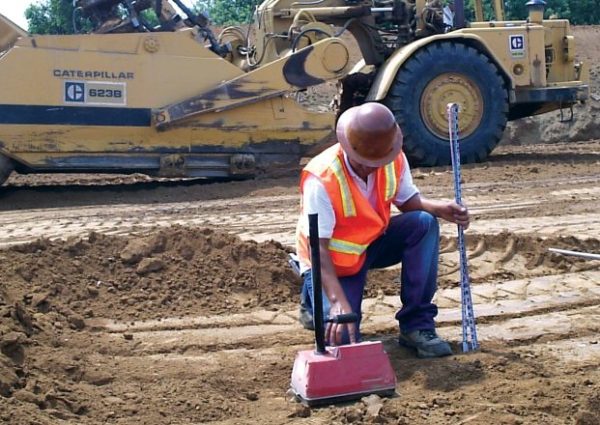
Earthwork and Geotechnical Engineering
Ground Truth. Sound Design.
Investigation • Analysis • Earthworks
Our Services

Earthwork & Geotechnical
Engineering

Every structure begins beneath the surface. Bangladesh's varied and often challenging subsurface conditions — from Dhaka's deep alluvial deposits to Chittagong's hilly rock formations — demand rigorous geotechnical investigation before any foundation or earthworks design can proceed safely.

Urban Engineering Limited provides the full geotechnical service chain: soil investigation and in-situ testing, laboratory analysis, geotechnical design, and earthworks engineering. Our team of experienced geotechnical engineers, engineering geologists, and field technicians has delivered ground investigation and design services across industrial, infrastructure, and commercial projects throughout Bangladesh — from routine building foundations to complex deep embankment and slope stability work.

Field

Investigation Teams

2017

Established

6+

Sectors Served
WHAT WE OFFER

Geotechnical & Earthworks Services

From subsurface investigation and laboratory testing through to full geotechnical and earthworks design — delivered by experienced specialists.

Soil Investigation & In-Situ Testing

Rotary and percussion borehole drilling, undisturbed and disturbed soil sampling, Standard Penetration Testing (SPT), Cone Penetration Testing (CPT/CPTU), vane shear testing, and permeability testing — providing the primary ground data underpinning all geotechnical design.

Soil & Rock Laboratory Testing

Full suite of laboratory tests including index properties (Atterberg limits, grain size, specific gravity, moisture content), consolidation, triaxial shear strength (UU, CU, CD), unconfined compression, CBR, and compaction tests — to quantify soil engineering parameters for design.

Foundation Engineering

Design of shallow foundations (spread footings, raft slabs) and deep foundations (bored and driven piles, micro-piles) — including bearing capacity analysis, settlement prediction, pile load capacity, and foundation monitoring for industrial plants, buildings, bridges, and utilities.

Earthworks Engineering

Geotechnical design of cut and fill, embankment construction, land reclamation, site platforming, and compaction specifications for industrial, infrastructure, and commercial development — including stability analysis, settlement monitoring, and field compaction quality control.

Geotechnical Hazard Mitigation

Assessment and mitigation of soft ground, slope instability, seismic liquefaction potential, subsidence, and expansive soils — including ground improvement recommendations (preloading, stone columns, deep soil mixing) and seismic site response analysis per BNBC requirements.

Slope Stability & Retaining Structures

Stability analysis of natural slopes, road and railway embankments, and excavations; design of retaining walls, sheet pile walls, and soil nail systems — with critical application to Chittagong hill-tract projects, riverbank developments, and urban basement excavations in Dhaka.

Geotechnical Investigation Bangladesh
Local Expertise

Engineering the Ground Beneath Bangladesh

Bangladesh's subsurface is dominated by young Holocene alluvial and deltaic deposits laid down by the Ganges-Brahmaputra-Meghna system over thousands of years. These soils present a distinctive set of geotechnical challenges that demand specialist knowledge — not generic textbook solutions.

High Groundwater Table

Shallow groundwater across most of the Bangladesh plain affects excavation stability, dewatering requirements, pile installation, and foundation heave risk — all carefully accounted for in our designs.

Deep Soft Clay & Consolidation Settlement

Thick sequences of soft, compressible clays and silts underlie much of Bangladesh. Primary and secondary consolidation settlement must be rigorously modelled for embankments, tank farms, and heavy structures founded on these soils.

Seismic Liquefaction Risk

Bangladesh's loose saturated sands, particularly in Sylhet, Chittagong, and the north-east, are susceptible to seismic liquefaction. Our site-specific seismic assessments follow BNBC 2020 and international practice to evaluate and mitigate this risk.

Chittagong Hill Tracts

The hilly south-east of Bangladesh presents entirely different geotechnical conditions — weathered rock, actively eroding slopes, and residual soils that demand different investigation and design approaches from the lowland delta context.

SOLVING DIFFICULT GROUND

Ground Improvement Techniques

When natural ground conditions are inadequate for the intended structure, ground improvement offers cost-effective alternatives to expensive deep foundation solutions.

Preloading & Surcharge

Accelerating primary consolidation of soft compressible clays by applying temporary surcharge loads — combined with vertical drains where required — to achieve target settlement before construction of the permanent structure.

Stone Columns & Vibro-Compaction

Densification of loose sands and reinforcement of soft cohesive soils using vibro-replacement stone columns — improving bearing capacity and reducing differential settlement under loaded platforms and floor slabs.

Lime & Cement Stabilisation

Chemical stabilisation of weak subgrades using lime or cement — particularly effective for improving trafficability of road subgrades and platform soils for industrial facilities on soft ground in Bangladesh.

Prefabricated Vertical Drains (PVD)

Installation of band drains to accelerate consolidation drainage paths in thick soft clay deposits — cutting consolidation time from years to months when combined with a preloading surcharge programme.

Geosynthetic Reinforcement

Design of geotextile, geogrid, and geocell reinforced soils for embankment bases on soft ground, reinforced retaining walls, and slope stabilisation — a cost-effective alternative to heavy concrete retaining structures.

Settlement Monitoring Instrumentation

Installation and reading of settlement plates, piezometers, inclinometers, and extensometers during ground improvement and construction — providing real-time data to verify design performance and confirm safe construction rate of fill.

OUR METHODOLOGY

Our Geotechnical Project Process

A systematic approach from desk study and field investigation through to design and construction support.

01
Desk Study & Scope Definition

Review of existing geological maps, previous investigation reports, and site history; definition of investigation scope and test programme appropriate to the project and ground conditions.

02
Field Investigation & Sampling

Borehole drilling, in-situ testing (SPT, CPT/CPTU, vane shear), and soil and rock sample collection — supervised by qualified geotechnical engineers to ensure data quality and completeness.

03
Laboratory Testing & Interpretation

Laboratory analysis of recovered samples; derivation of design soil parameters; preparation of borehole logs, cross-sections, and geotechnical model for the site.

04
Geotechnical Design & Site Support

Foundation and earthworks design, geotechnical report production, and continued geotechnical support during construction — including review of pile records, compaction testing, and resolution of unforeseen ground conditions.

OUR ADVANTAGE

Why Choose Urban Engineering

Field experience, local subsurface knowledge, and the analytical depth to turn raw ground data into safe, cost-optimised designs.

From the Ground Up — Safe, Optimised, and Built to Last

Investigation • Design • Ground Improvement • Construction QA

Poor ground conditions are among the most common causes of construction cost overruns and structural failures in Bangladesh. Our geotechnical team eliminates ground risk through thorough investigation, rigorous analysis, and pragmatic engineering — so your structure sits on a foundation you can trust.

SPT & CPT Expertise

In-house drilling rigs and CPT equipment operated by trained technicians — no reliance on subcontracted investigation crews.

BNBC 2020 Compliance

All geotechnical designs and seismic site classifications prepared in full compliance with BNBC 2020 requirements.

Alluvial Soil Specialists

Deep knowledge of Bangladesh's Holocene deltaic soils — soft clays, loose sands, organic deposits, and the behaviour that makes them challenging to build on.

Liquefaction Assessment

Site-specific seismic liquefaction potential evaluations using SPT and CPT-based methods in accordance with current international practice.

Cost-Optimised Design

We balance safety with economy — recommending the most practical and cost-effective foundation and earthworks solution for each project's ground conditions.

Construction-Phase Support

Geotechnical engineers on site during critical earthworks and foundation phases — reviewing pile records, testing fill compaction, and responding to ground surprises in real time.

COMMON QUESTIONS

Frequently Asked Questions

Common questions about geotechnical site investigation, foundation design, and earthworks engineering in Bangladesh.

  • Why is a geotechnical investigation necessary before construction?

    A geotechnical investigation is essential because the ground beneath a site cannot be assumed — it must be measured. Without site-specific data on soil stratigraphy, strength, compressibility, and groundwater conditions, it is impossible to design foundations reliably. In Bangladesh especially, ground conditions are highly variable: a site that looks level and uniform at the surface may contain lenses of soft organic clay, loose saturated sand, or filled ground at shallow depth that would cause catastrophic settlement or failure if not identified and accounted for in design. Skipping or under-scoping geotechnical investigation is one of the costliest mistakes a construction client can make — the savings are tiny compared to the remediation costs if ground problems emerge during or after construction.

  • The Standard Penetration Test (SPT) is performed inside a borehole by driving a split-barrel sampler into the soil with a standard drop hammer — counting the blow count (N-value) required to advance 300mm. It provides a discrete measure of soil resistance at intervals down the borehole and allows soil samples to be recovered for visual description and laboratory testing. The Cone Penetration Test (CPT/CPTU) pushes an instrumented cone probe into the ground at a constant rate, providing a virtually continuous record of tip resistance, sleeve friction (and pore water pressure in CPTU) with depth. CPT provides much higher resolution of soil stratigraphy and is particularly good at identifying thin weak layers. Both tests have strengths and limitations — Urban Engineering selects the appropriate test programme, or a combination of both, based on the project requirements and ground conditions.

  • Seismic liquefaction occurs when loose, saturated sand loses its strength during earthquake shaking — behaving temporarily like a liquid and causing foundations to sink or tilt. Bangladesh, particularly the Sylhet, Chittagong, and north-eastern regions, has significant seismic hazard, and many sites are underlain by loose saturated sands that are susceptible. Liquefaction potential is assessed using SPT N-values or CPT data combined with the site-specific Peak Ground Acceleration (PGA) from BNBC 2020 seismic zoning maps, following the Youd et al. or Idriss & Boulanger simplified methods. Where liquefaction risk is identified, mitigation options include: densification of loose sands using stone columns or dynamic compaction; deep foundations bearing below the liquefiable layer; or structural measures such as mat foundations that can span areas of locally weakened ground. Urban Engineering provides full liquefaction assessment reports and ground improvement recommendations as part of our geotechnical design service.

  • The choice between ground improvement and deep foundations depends on several factors: structural loads, tolerable settlement limits, the depth and nature of weak soil, site access, programme, and cost. Ground improvement — preloading, stone columns, vertical drains, lime/cement stabilisation — is often more economical for large-area loaded platforms such as industrial tank farms, warehouse floor slabs, and road embankments where the loading is distributed over a wide area and some residual settlement after treatment is acceptable. Piled foundations are typically preferred where structural loads are concentrated (column loads), settlement tolerances are very tight (sensitive structures or machinery), or where weak layers extend to great depth making improvement impractical. Urban Engineering evaluates both options for every project and recommends the solution that best balances technical performance, construction risk, and cost for the specific site and structure.